How digital identification works in Finland: bank IDs, mobile certificates, the ID card, eIDAS login for EU citizens, and the Suomi.fi wallet and digital ID card coming in 2027.
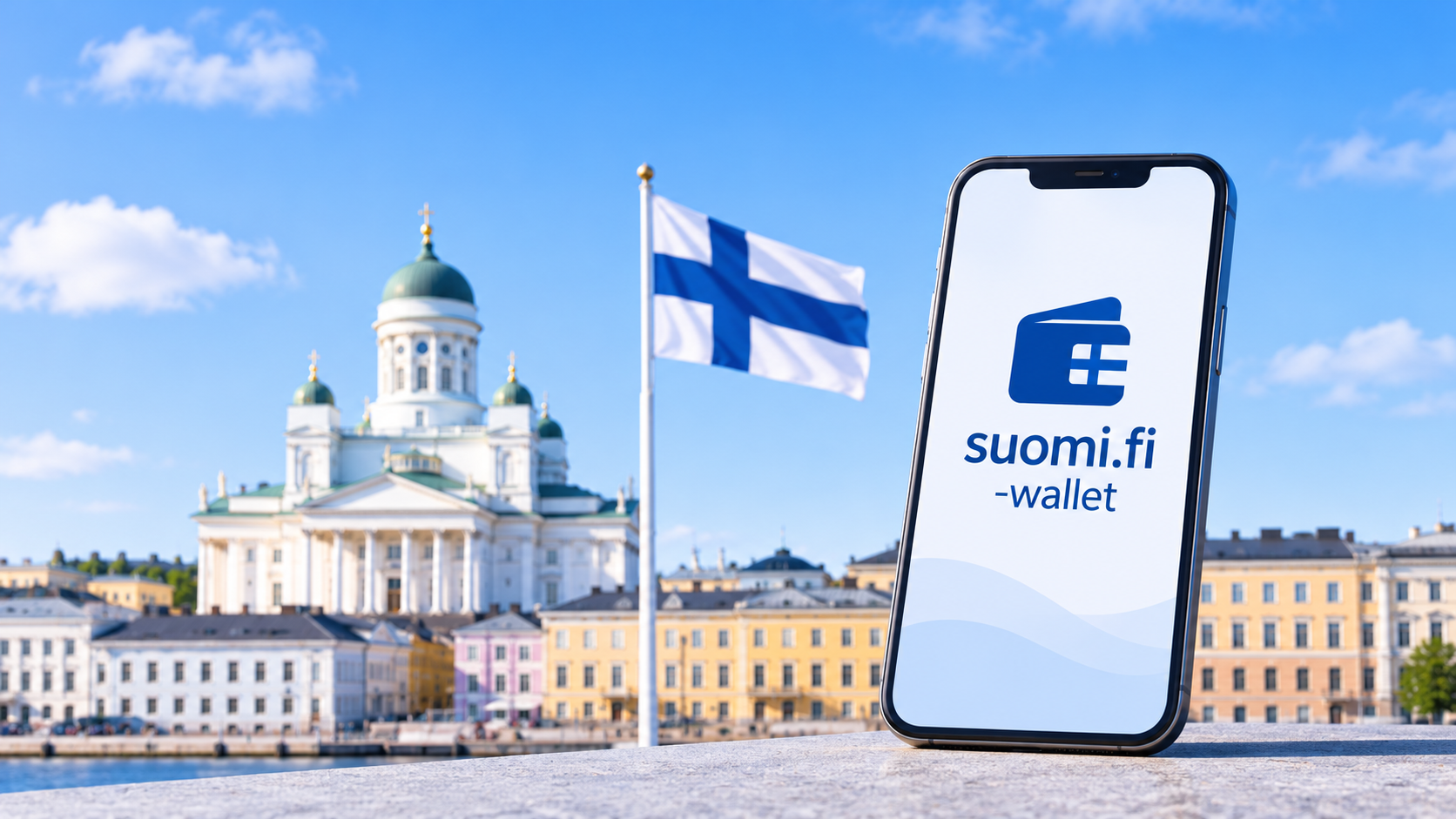
Most people in Finland identify themselves online with their bank IDs (pankkitunnukset) or a mobile certificate (mobiilivarmenne). A smaller group uses the chip on the national ID card. Citizens of other EU countries can log in to many public services with their own country's eID. In 2027, the Suomi.fi wallet arrives providing a fourth option for people to securely identify themselves. Suomi.fi wallet is Finland's EU Digital Identity Wallet. Along with it, a digital identity card will be issued by the police.
Finland calls this "strong electronic identification" (vahva sähköinen tunnistaminen). It is regulated by law, and providers are supervised by the Finnish Transport and Communications Agency Traficom. According to Traficom's National Cyber Security Centre, the main methods are:
Bank ID: These are the most common. The same login you use for your online bank works across thousands of service ranging from the tax office to insurers.
Mobile certificate: These are issued by mobile operators. Mobile certificate in Finland is a joint service of operators Elisa, DNA and Telia. It is tied to your phone number. You choose it at login, confirm a code on your phone and enter a PIN. Registering online requires bank IDs, or you can register in a shop with a valid passport or ID card (Elisa).
Public services usually use Suomi.fi identification (Suomi.fi-tunnistus), the national login service run by DVV. It shows you all supported methods on one screen.
For citizens of other EU countries, Suomi.fi also supports login with notified eIDs from other member states under the eIDAS regulation. Countries' eIDs become available at different times, so coverage depends on your country (Vero). Foreign companies dealing with Finnish authorities can use the Finnish Authenticator service.
Private companies don't contract with every bank and operator. They buy a single connection from an identification broker (tunnistusvälittäjä), which gives access to all bank and operator methods through one contract and one interface. Traficom keeps a public register of supervised providers (Kyberturvallisuuskeskus).
However, these methods are designed for people with a Finnish identity and Finnish bank or phone relationship. Customers from other countries usually can't use them. Therefore, this creates a gap for international businesses.
DVV is currently building Finland's EU Digital Identity Wallet, the Suomi.fi wallet. It is free, voluntary, and will be offered to Finnish citizens and permanent residents. It supports strong identification and electronic signing, and DVV describes it as a higher assurance level than bank IDs and mobile certificates. However, it does not replace those methods or physical documents (DVV).
In addition, the police together with DVV, will issue a digital ID that lives in the wallet. It will be available to Finnish citizens and foreigners residing in Finland who hold a valid Finnish passport or ID card. It is not a travel document, but for in-person transactions it is treated like a passport or ID card. The Act on the Digital Identity Card (812/2026) entered into force on 1 October 2026, and the card itself is expected in the wallet during 2027 (Mobiili.fi).
Because every EU country must offer a wallet, a Finnish service that accepts the Suomi.fi wallet can technically accept wallets from other EU countries too. That closes the gap that bank IDs leave open.
Selling only to Finns: bank IDs and mobile certificate via a broker remain the standard. Add the wallet when it launches.
Selling to people across the EU: the wallet is the first method that works the same way for a Finn and a German.
Regulated sectors (banking, payments, telecoms and others) have to accept the wallet on user request from December 2027.
Authbound verifies EUDI Wallets, including the Suomi.fi wallet and wallets from other EU countries, through one API that sits next to your existing identification. Read our Finnish guide on bank IDs versus the EUDI wallet, see how to accept wallets from other EU countries, or write to info@authbound.io.
Kyberturvallisuuskeskus (Traficom), strong electronic identification for online services (in Finnish): https://www.kyberturvallisuuskeskus.fi/fi/tunnistus-ja-luottamuspalveluiden-saantely/vahvista-verkkopalvelusi-turvallisuutta-ottamalla-kayttoon-vahva-sahkoinen-tunnistus
Elisa, Mobiilivarmenne (in Finnish): https://elisa.fi/varmenne/
Finnish Tax Administration, eIDAS identification (in Finnish): https://vero.fi/tulorekisteri/yritykset-ja-organisaatiot/asioi-sahkoisesti/tunnistaudu/eidas-tunnistus/
DVV, frequently asked questions about the European Digital Identity Wallet (in Finnish): https://dvv.fi/usein-kysyttya-eurooppalaisesta-digitaalisesta-identiteettilompakosta
Act on the Digital Identity Card 812/2026 (in Finnish), Finlex: https://www.finlex.fi/fi/lainsaadanto/2026/812
Mobiili.fi, "Digitaalinen henkilötodistus tulee suomalaisille vuonna 2027", 23 October 2026: https://mobiili.fi/2026/10/23/digitaalinen-henkilotodistus-tulee-suomalaisille-vuonna-2027/
The EUDI Wallet is moving from pilots to deployment. Learn what businesses need to do now to verify credentials, register as relying parties, and prepare for 2027.

Learn how EUDI Wallet authentication can replace passwords and SMS OTPs with cryptographic, high-assurance identity verification for B2B platforms.
Mobile driving licences (mDLs) are moving from pilots to production in the EU. Learn what mDLs can and cannot do, how proximity and online flows differ, and what car rentals, airlines, and other verifiers need to prepare.